Overview
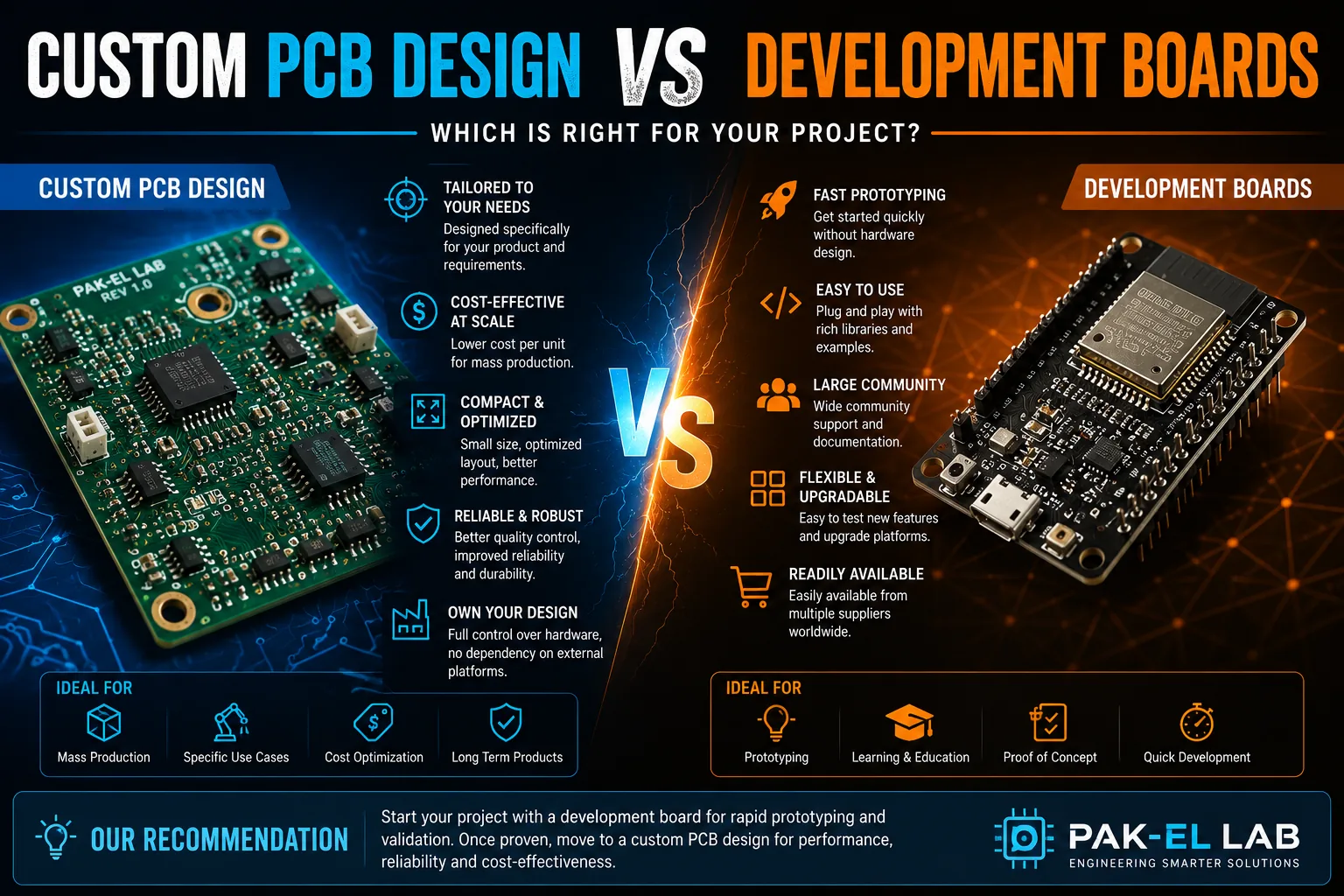
Almost every hardware product starts life on a development board — an Arduino, an ESP32 DevKit, an STM32 Nucleo, a Raspberry Pi. That's exactly what these boards are for: fast, low-risk proof of concept. The question that matters is when, and whether, to move off that board onto a custom PCB. Get the timing wrong in either direction — designing custom too early, or staying on a dev board too long — and it shows up later as wasted budget, a product that can't scale, or a design that has to be redone from scratch right before launch.
What Development Boards Are Good At
Dev boards exist to remove uncertainty at the start of a project. They give you a known-good power section, a programmed bootloader, breakout headers for every peripheral, and a huge base of example code and community support. For proving a concept, validating a sensor combination, or demoing to a stakeholder, nothing beats the speed of wiring a dev board and having firmware running the same day. The mistake is treating that convenience as a production strategy — dev boards are priced, sized, and certified for prototyping, not for shipping thousands of units.
Where Dev Boards Stop Scaling
Three things break down as volume grows. First, cost: a dev board bundles far more functionality — USB-serial bridges, extra regulators, unused connectors — than any single product needs, and you pay for all of it on every unit. Second, size: dev boards are laid out for accessibility, not for fitting inside an enclosure, so anything space-constrained outgrows them immediately. Third, reliability and certification: a dev board was never designed or tested to your product's specific environmental, EMC, or regulatory requirements, and pushing it into the field as-is is a liability once volumes rise.
What Custom PCB Design Buys You
A custom board strips out everything the product doesn't need and adds exactly what it does — the right connector footprint, the right power budget for the enclosure and battery, a layout that's been through EMC and thermal review, and a bill of materials chosen for supply availability and unit cost at your actual volume. The upfront engineering cost is real, but it's a fixed, one-time cost that amortizes across every unit built afterward, whereas the dev-board premium is paid again on every single unit forever.
How to Decide: A Practical Framework
Stay on a dev board while you're still validating the concept, changing sensors or connectivity choices frequently, or building fewer than a handful of units. Move to a custom board once the design is functionally stable, the enclosure and mechanical form factor are defined, and you're planning a production run where per-unit cost, size, or regulatory compliance actually matters. Many products go through an intermediate step — a "breakout" custom board that mirrors the dev board's pinout but in the target form factor — to de-risk the transition before committing to a fully optimized final layout.
How PAK-EL LAB Can Help
PAK-EL LAB takes products from dev-board prototype to production-ready custom PCB — schematic capture, layout, component sourcing, and DFM review sized for your actual volume and enclosure. If you're weighing when to make that move, our team can help you scope it before you commit budget.
Related service: PCB Design