Introduction
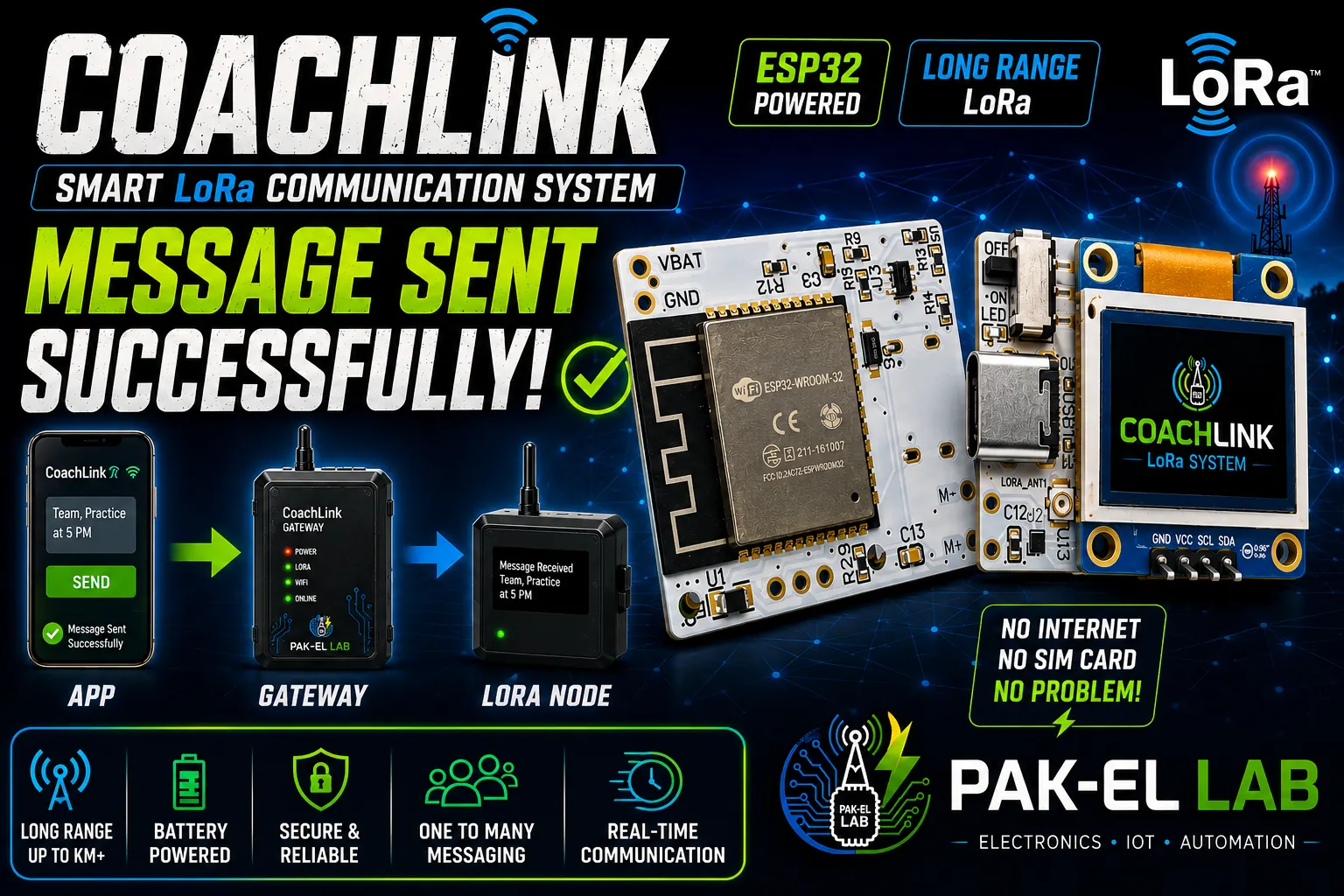
Modern IoT systems need reliable communication across long distances, especially where Wi-Fi, Bluetooth, mobile data, or internet coverage is limited. PAK-EL LAB developed the CoachLink ESP32 LoRa Communication System as a practical example of ESP32 long-range communication, demonstrating real-time wireless messaging between a mobile app, ESP32 gateway, and remote LoRa node.
This project is designed for long-range communication, low-power operation, and scalable IoT deployment. It is suitable for industrial automation, smart agriculture, marine monitoring, remote sensor networks, and custom electronics products.
Project Video Demonstration
Watch the project demo below. The mobile app sends a message to the gateway, and the gateway forwards it to the LoRa node successfully.
Problem
Many remote communication systems fail because Wi-Fi range is short, cellular networks require SIM cards, and internet-based systems are not always available in field locations. These issues increase cost, reduce reliability, and make deployment difficult in remote environments.
Solution
PAK-EL LAB designed an ESP32-powered LoRa gateway and LoRa node system. The mobile application communicates with the gateway, while the gateway uses LoRa to communicate with remote nodes. This enables real-time messaging without internet or SIM card dependency.
Communication flow: Mobile App → ESP32 Gateway → LoRa Network → Remote LoRa Node
Hardware Design
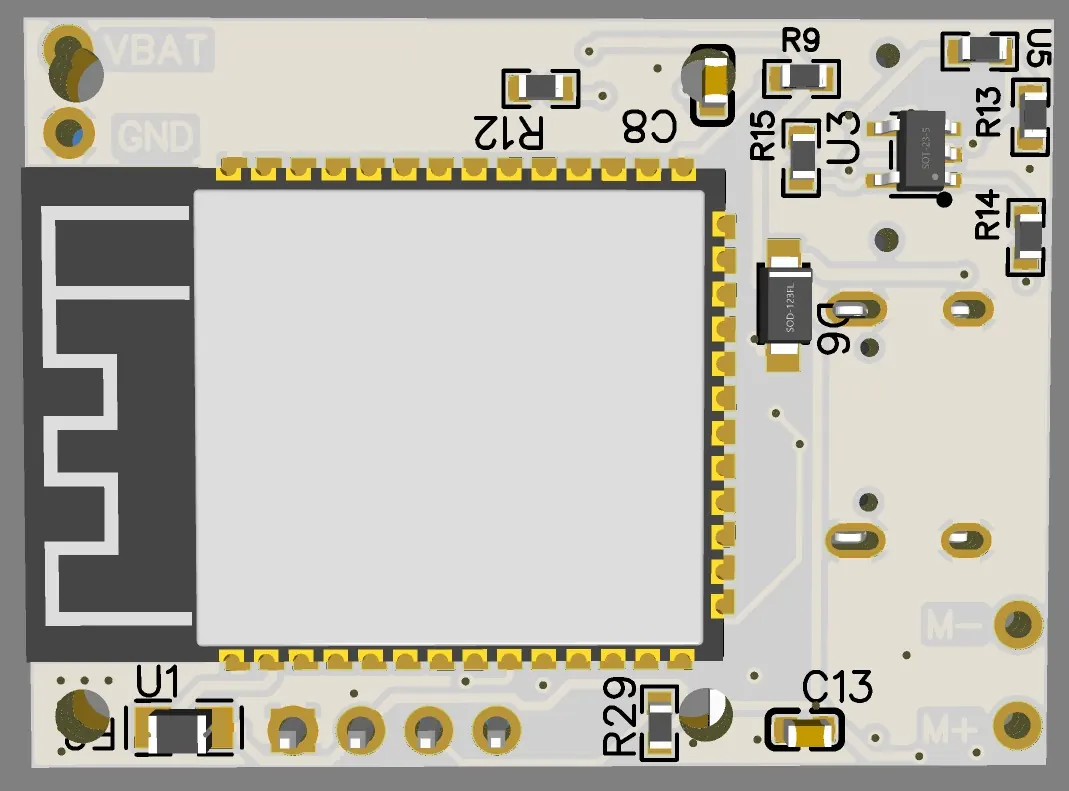
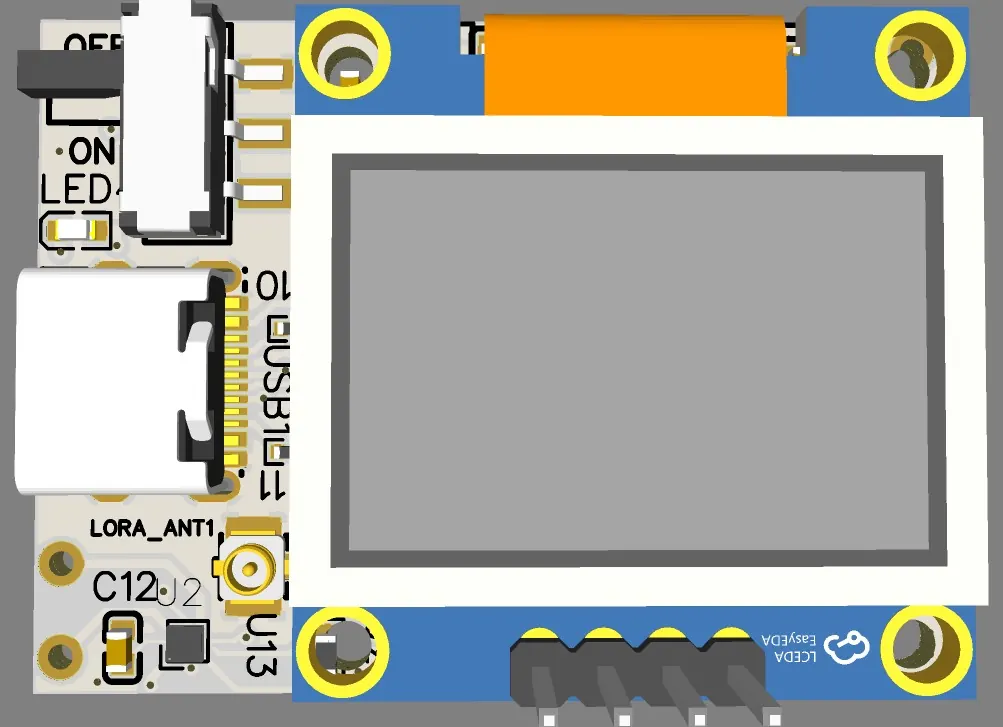
The hardware includes ESP32-based control, LoRa wireless communication, OLED display support, battery-powered operation, and custom PCB design. The design can be customized for different sensor inputs, power sources, enclosures, and industrial requirements.
Advantages
- Long-range wireless communication
- No internet or SIM card required
- ESP32-powered smart gateway
- Battery-powered remote node support
- Secure and reliable communication design
- One-to-many messaging capability
- Real-time message transmission
- Custom PCB and firmware development
Applications
- Industrial automation and monitoring
- Smart agriculture and irrigation systems
- Marine and offshore monitoring
- Remote sensor networks
- Security and field communication systems
- IoT product development
- Wireless control systems
Expected Range and What Affects It
Real-world LoRa range varies enormously with terrain, obstructions and antenna placement — published "kilometres" figures are almost always measured in open line-of-sight conditions, not through buildings, trees or hilly terrain. For a gateway-and-node link like CoachLink's, the factors that move range the most are antenna height above ground, buildings or dense vegetation in the path, and the spreading factor chosen in firmware, which trades data rate for range and receiver sensitivity. Treat any published range figure as a best case, and budget field-testing time to confirm real performance at the actual deployment site.
Frequency and Regional Considerations
LoRa operates in different unlicensed sub-GHz bands by region — commonly 868MHz in Europe, 915MHz in North America, and other allocations elsewhere — each with its own regulatory duty-cycle or dwell-time limits on how much a node can transmit. A radio and antenna tuned for one region's frequency plan isn't automatically compliant or even functional in another, so the target deployment region needs to be confirmed before module and antenna selection, not adjusted afterward.
Antenna Placement and Matching
The antenna is often the single biggest factor separating a LoRa link that performs as expected from one that doesn't. It needs to be matched to the module's actual output frequency, mounted with adequate clearance from ground planes and metal enclosures, and positioned with as clear a line of sight as the installation allows. Mounting a node's antenna inside a metal enclosure or behind other electronics can quietly cut range by a large margin without any obvious fault in the firmware.
Understanding Link Budget
Link budget is the running total of every gain and loss between a transmitter and receiver — transmit power, cable and connector losses, antenna gain at both ends, and free-space path loss over distance — compared against the receiver's sensitivity floor. A link with margin to spare tolerates the day-to-day variation of a real environment, such as rain, foliage growth, or a vehicle parking in the path. A link designed with zero margin against a best-case range figure is the kind that works in testing and then fails intermittently once deployed.
Point-to-Point vs LoRaWAN
The CoachLink system uses a direct point-to-point LoRa link between gateway and node rather than LoRaWAN. Point-to-point is simpler to implement and doesn't require a network server or gateway infrastructure beyond the device pair itself, which fits a one-to-many or small-node-count deployment well. LoRaWAN adds a standardised network layer — device addressing, encryption key management, and often a third-party network server — that becomes worth the added complexity once a deployment scales to many independent nodes reporting to shared infrastructure.
One-to-Many Messaging: One ESP32 Gateway, Several Nodes
LoRa is a shared, half-duplex radio channel: every node set to the same frequency, spreading factor and bandwidth hears every packet. That makes one-to-many messaging natural — the ESP32 gateway can broadcast a single packet that every node receives, or address one node directly — but only one device can transmit on a channel at a time, so the protocol has to manage who talks when.
- Addressing: put a destination ID and the sender's ID in the first bytes of every payload. Each node ignores packets that aren't addressed to it or to a shared broadcast ID.
- Acknowledgements: acknowledge addressed messages per node, but don't let every node acknowledge a broadcast at the same moment — the replies collide. Stagger them with a short node-specific delay, or have the gateway poll nodes in turn.
- Airtime: a packet's time on air grows sharply with spreading factor, and regional duty-cycle limits (1% on many EU 868MHz sub-bands) cap how often the gateway may transmit. Keep messages short and budget airtime for the number of nodes you plan to support.
- Scaling: tens of nodes exchanging occasional messages work well on a simple point-to-point protocol. With many more nodes, or nodes transmitting at random times, LoRaWAN's network server and channel management usually pay for themselves.
Planning a multi-node system? Our IoT product development team designs the gateway, node hardware and messaging protocol together, so range, battery life and reliability are engineered rather than discovered in the field.
Packet Reliability and Acknowledgements
LoRa's physical layer doesn't guarantee delivery on its own — a message can be lost to interference, an obstruction, or the node being out of range at the moment it's sent. Reliable messaging needs an application-level acknowledgement scheme: the receiver confirms receipt, and the sender retries after a timeout if no acknowledgement arrives. Skipping this is a common cause of "it usually works" systems that quietly drop messages under real-world conditions.
Security
Point-to-point LoRa links are not encrypted by default, so application-level encryption on the payload is worth adding for anything beyond a demo, particularly since LoRa's long range means a signal can potentially be received well outside the intended deployment area. LoRaWAN handles this differently, with encryption and key management built into the protocol's device-activation process.
Common LoRa Design Mistakes
- Sizing range from a datasheet's best-case figure instead of testing with the actual enclosure and antenna placement.
- Mounting the antenna inside a metal enclosure or too close to a ground plane.
- Skipping application-level acknowledgements and assuming every transmitted packet arrives.
- Choosing a frequency/region setting that doesn't match where the product will actually be deployed.
- Leaving payload data unencrypted on a link expected to carry anything sensitive.
When LoRa Is Not the Right Choice
LoRa is the wrong tool when a product needs to move meaningful amounts of data — images, audio, or frequent high-resolution telemetry — since its data rates are far below Wi-Fi or cellular. It's also a poor fit when low latency matters more than range or power, since duty-cycle limits and typical LoRa payload sizes aren't built for fast round-trip messaging. For those cases, Wi-Fi, BLE or a cellular module usually solves the problem better than forcing a long-range, low-bandwidth radio into a job it wasn't designed for.
Practical Implementation Checklist
- Confirm the target deployment region and its LoRa frequency/duty-cycle rules before selecting a module.
- Plan antenna placement and enclosure design together, not as an afterthought.
- Estimate an approximate link budget with margin, rather than relying on a best-case range figure.
- Decide point-to-point vs LoRaWAN based on how many nodes the deployment will eventually need.
- Add application-level acknowledgements for any message that matters if lost.
- Add payload encryption if the link will carry anything sensitive.
- Field-test range and reliability at the actual deployment site before finalising the design.
Conclusion
The CoachLink ESP32 LoRa Communication System proves that reliable long-range messaging can be achieved without depending on internet or SIM cards. With a custom gateway, LoRa node, mobile app, and PCB design, this project is a strong foundation for professional IoT and industrial communication products.
Frequently Asked Questions
What is the ESP32 LoRa Communication System?
It is a long-range wireless IoT system that connects a mobile app, ESP32 gateway, and remote LoRa node for real-time communication.
Does this system require internet?
No. The LoRa communication link can work without internet and without a SIM card.
Can this be customized for my project?
Yes. PAK-EL LAB can customize the PCB, firmware, mobile app, gateway, node, and communication protocol.
Where can this project be used?
It can be used in industrial automation, agriculture, marine monitoring, remote sensing, and custom IoT products.
Need Similar Development?
PAK-EL LAB provides professional PCB design, ESP32 firmware development, LoRa communication systems, IoT product development, Android/iOS apps, and automation solutions.
Related services: RF, LoRa & Satellite Communication · ESP32 & UWB Development · Embedded Firmware Development
See this system summarised alongside our other work on the portfolio page, or contact us to discuss a similar project.
Website: pakellab.com
Email: tahir@pakellab.com
WhatsApp: +92 345 1616967