Overview
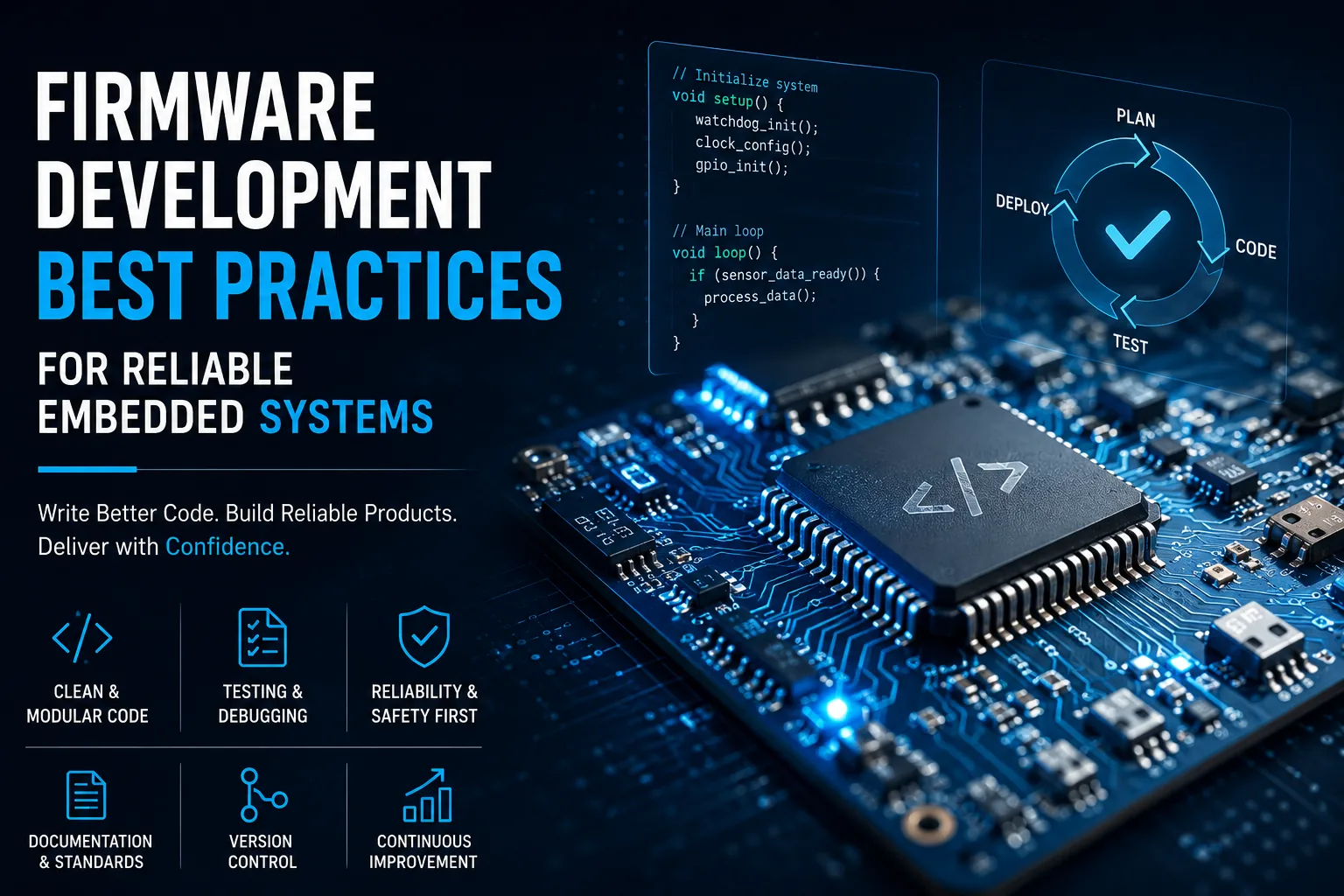
Hardware failures are usually obvious — a board doesn't power on, a sensor reads garbage. Firmware failures are quieter: a device that works perfectly on the bench and then locks up intermittently three weeks into a field deployment, or a fleet that can't be updated once it's out of physical reach. Reliable embedded firmware isn't the product of a single clever fix — it comes from architectural decisions made early, disciplined debugging habits, an update path designed in from day one, and testing that goes beyond "it compiles and runs once."
Firmware Architecture
The single biggest architectural decision is how work gets scheduled. A superloop (a bare `while(1)` with everything running in sequence) is fine for simple, single-purpose firmware, but anything juggling sensors, communication, and timing constraints benefits from a real-time operating system or at least an event-driven, interrupt-and-state-machine structure. The goal is to keep interrupt service routines short — set a flag or push to a queue and get out, then handle the actual work in the main context — because long ISRs are a common source of missed timing and hard-to-reproduce bugs. Choosing a microcontroller with headroom to spare also matters here; our ESP32 vs STM32 vs RP2040 comparison covers how platform choice constrains architecture from the start.
Modular separation between drivers, business logic, and communication layers pays off the first time a sensor or radio module changes — which, on a multi-year product, it eventually will. Firmware that hard-codes a specific driver's calls throughout the application layer turns every hardware revision into a full rewrite instead of a driver swap.
Debugging Techniques
Print statements and blinking LEDs still have their place, but they don't scale to intermittent, timing-sensitive bugs. A hardware debugger with breakpoints and step-through execution over SWD or JTAG finds root causes in minutes that print debugging can take days to chase. Just as valuable is defensive instrumentation: a watchdog timer that resets the device if the main loop stalls, a persistent crash log that survives a reset and records the fault address and stack, and brownout detection that catches power-related resets before they masquerade as firmware bugs. Devices in the field can't be plugged into a debugger, so the failures that matter most are exactly the ones instrumentation needs to catch on its own.
OTA Update Design
Any product that ships more than a handful of units needs an over-the-air update path designed before the first firmware version goes out, not retrofitted after a bug is discovered in the field. A dual-bank (A/B) update scheme, where the new image is written to an inactive partition and only marked active after it boots successfully, is the standard way to avoid bricking a device on a failed update — if the new image doesn't come up cleanly, the bootloader falls back to the known-good bank automatically. Signing update images and verifying the signature before flashing prevents a compromised or corrupted binary from ever running, which matters even more for internet-connected devices than for isolated ones.
Bandwidth and power both constrain how OTA gets delivered — a battery-powered LoRa node can't pull the same multi-megabyte image a mains-powered Wi-Fi gateway can, so update size and delivery frequency have to be designed against the same power budget covered in our piece on reducing power consumption in battery-powered IoT devices.
Testing and Validation
Unit testing hardware-independent logic on a desktop build — parsing, protocol encoding, state machine transitions — catches a large share of bugs before they ever touch real hardware, and it's far faster to iterate on than flashing a target board for every change. Hardware-in-the-loop testing closes the gap for the logic that unit tests can't reach: running the actual firmware against real or simulated peripherals to catch timing and driver issues that a desktop build never sees. Soak testing — running firmware continuously for days under realistic load — is what surfaces memory leaks, heap fragmentation, and rare race conditions that a five-minute bench test simply won't trigger before it ships.
Edge-case testing deserves equal weight: brownout during a flash write, a sensor that disconnects mid-read, a network link that drops halfway through an OTA transfer. These aren't rare in the field — they're the normal operating conditions of anything battery-powered or wirelessly connected, and firmware that only handles the happy path will eventually meet every one of them.
Version Control and Release Management
Every firmware image that leaves the building should be traceable back to an exact, tagged commit — not "whatever was on the build machine that day." Embedding a build version and git hash into the binary itself, readable over a debug interface or a status command, turns "which firmware is this device running" from a guessing game into a one-line query, which matters enormously when triaging a field issue months after deployment. Keeping a changelog per release and never reusing a version number are small disciplines that pay for themselves the first time two firmware builds behave differently and nobody can say why.
How PAK-EL LAB Can Help
PAK-EL LAB builds embedded firmware with this discipline from the first architecture decision — modular code, watchdog and fault-recovery design, secure OTA update paths, and a testing strategy matched to how the product will actually be deployed. If reliability in the field is a requirement, not an afterthought, our team can help you get there.
Related services: Embedded Firmware Development · IoT Product Development