Overview
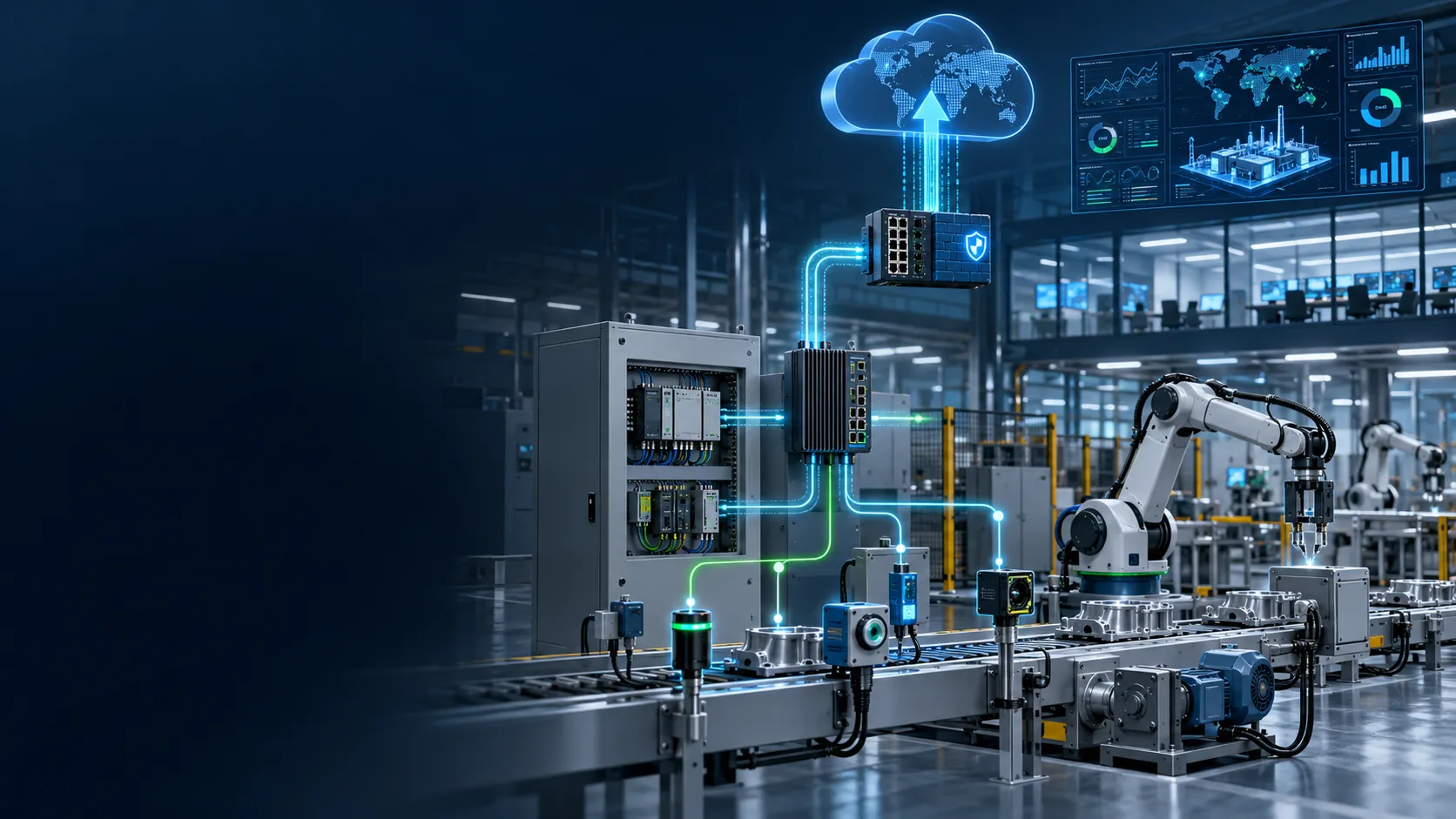
An industrial IoT deployment is rarely one device talking to one cloud service — it is a layered system, and most of the reliability problems that show up months after commissioning trace back to a weak link in that chain rather than a single bad sensor. A working architecture has to get four layers right at once: the field sensors and actuators, the edge gateway that aggregates and pre-processes their data, the network and protocol carrying it upstream, and the cloud platform that stores, analyzes, and acts on it. Skipping the design work on any one layer to save time up front is consistently the most expensive shortcut a project can take.
The Sensor and Field Device Layer
Field-level sensors in industrial settings still lean heavily on the same interfaces that have worked for decades — 4-20mA current loops for process variables, digital fieldbus signals for discrete I/O, and increasingly wireless sensor nodes where running cable isn't practical. The architectural decision at this layer is less about the sensor itself and more about where the analog-to-digital conversion happens: converting close to the sensor and sending digital data upstream avoids the noise pickup that a long analog run through an electrically busy plant is prone to, at the cost of adding a small amount of electronics at every measurement point.
Edge Gateways: Aggregation and Local Intelligence
The gateway is where a collection of individual sensors becomes a system. It aggregates readings from multiple field devices, converts between field protocols (Modbus, HART, proprietary sensor buses) and the IP-based protocol going upstream, and increasingly runs local logic — threshold alerts, basic anomaly detection, or short-term buffering — so the system keeps functioning usefully even if the upstream link drops. A gateway with no local intelligence turns every network hiccup into a data gap; one that pre-processes and buffers turns the same hiccup into a brief delay once connectivity returns.
Protocols: MQTT, OPC UA, and Modbus TCP
MQTT's lightweight publish/subscribe model suits high-frequency telemetry from many devices over constrained links, and it has become the default choice for gateway-to-cloud reporting. OPC UA is the more common choice where interoperability with existing industrial control systems and structured, self-describing data models matter more than raw efficiency — it is widely supported across SCADA and PLC vendors specifically for that reason. Modbus TCP over standard wired automation networking remains the pragmatic choice for gateways bridging to legacy Modbus RTU field devices, since it requires no protocol translation beyond wrapping the existing register model in TCP/IP. Most real deployments end up running more than one of these simultaneously, translating between them at the gateway rather than forcing every device onto a single protocol.
Network Reliability and Redundancy
Industrial sites are hostile to both wireless and wired links — RF interference from motors and VFDs on one side, physical damage and connector wear on the other — so a resilient IIoT architecture assumes the primary link will fail occasionally and plans for it rather than treating it as an edge case. Common patterns include a wired Ethernet backbone with a cellular failover path for the gateway's cloud connection, and local data buffering deep enough to cover the typical outage duration seen on site, not just a lab-tested worst case. Retrofitting redundancy after a deployment has already gone live is far more disruptive than designing the failover path in from the start.
Cloud Integration and Data Handling
Once data reaches the cloud, the architecture decision shifts to storage and processing: time-series databases suit the high-volume, timestamped sensor data IIoT systems generate far better than a general-purpose relational database, and most cloud IoT platforms (AWS IoT, Azure IoT Hub, or a custom backend) build around that assumption. Device provisioning and per-device credentials matter here too — a fleet of gateways sharing one hard-coded API key is a security liability that scales badly and is expensive to fix retroactively once devices are already deployed in the field.
Security Across the Stack
Security has to be designed in at every layer rather than bolted onto the cloud endpoint alone: TLS on every network hop, device-unique credentials provisioned during manufacturing, and network segmentation that keeps the OT (operational technology) network separate from general IT infrastructure. A gateway that bridges both networks is a natural target, and it deserves the same security scrutiny as the cloud platform it connects to, not less.
Managed vs Custom Cloud Platforms
Choosing between a managed IoT cloud platform (AWS IoT Core, Azure IoT Hub) and a custom backend is mostly a question of how much control the project needs versus how quickly it needs to ship. A managed platform handles device provisioning, message routing, and much of the security groundwork out of the box, which is hard to justify rebuilding from scratch unless the deployment has requirements a managed platform genuinely can't meet — data residency rules that require self-hosting, or integration with an existing on-premises historian that predates any cloud platform on site. Most industrial deployments are well served by a managed platform for ingestion and device management, with custom application logic built on top rather than replacing the whole stack.
How PAK-EL LAB Can Help
PAK-EL LAB designs industrial IoT systems end to end — sensor interfacing, edge gateway hardware and firmware, protocol integration, and cloud connectivity — built to keep working through the network and power conditions a real industrial site produces. If you're planning an industrial IoT deployment, our team can help architect it from the sensor up.
Related services: Automation Systems · IoT Product Development