Overview
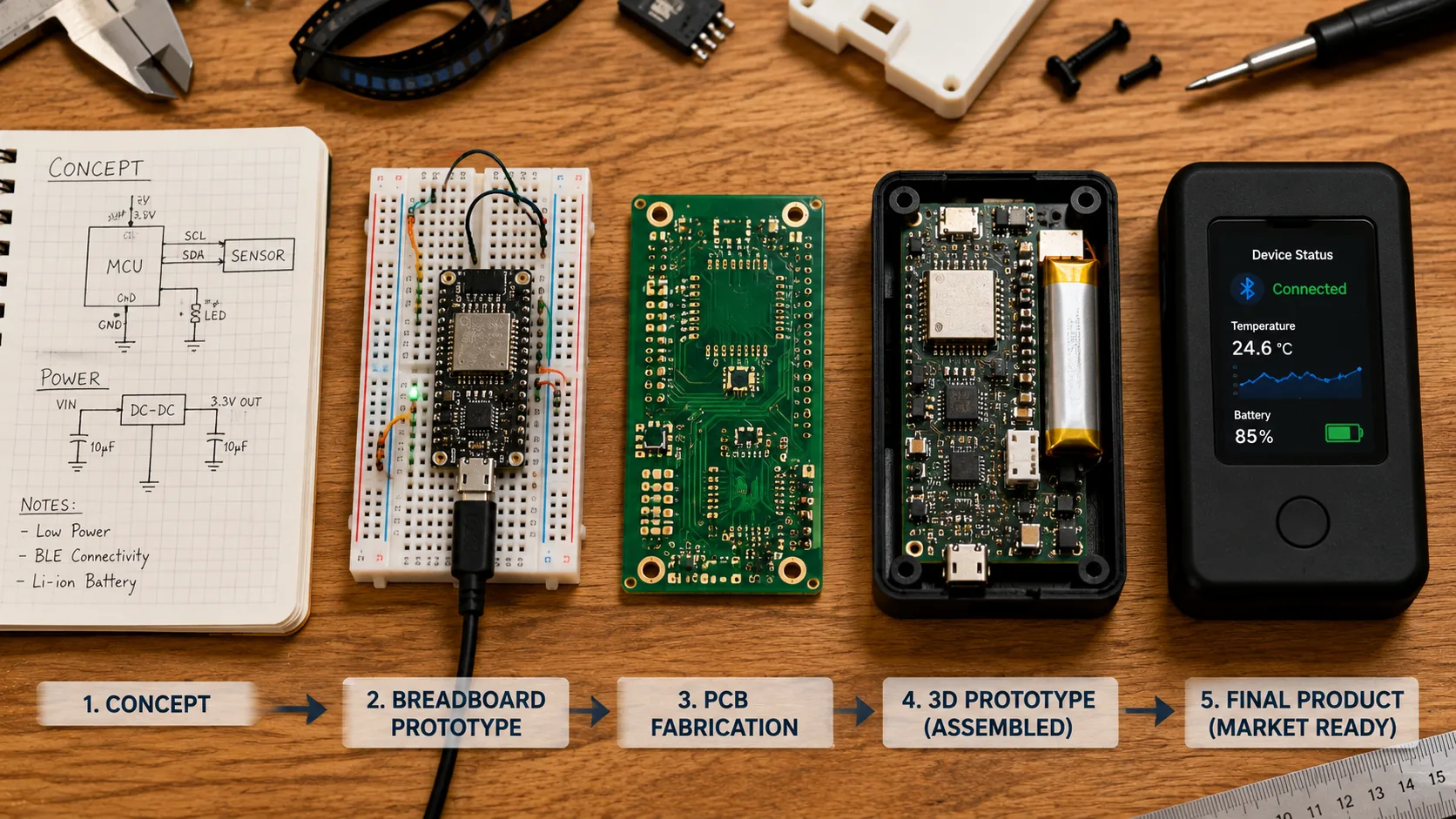
Every hardware product that reaches customers travels roughly the same path: an idea, a set of requirements, several rounds of prototypes, validation against real-world conditions, and finally a design a factory can build repeatedly without surprises. Teams that treat this as a straight line from sketch to shipping product are usually the ones re-spinning boards months after launch. Teams that treat each stage as a checkpoint, with real decisions made and real risks retired before moving on, are the ones that ship on schedule and are not called back to fix a design flaw a customer found first.
Requirements and Feasibility
Every product decision downstream traces back to requirements that were never written down clearly enough. Before a single schematic is drawn, the questions worth answering in detail are: what does the product need to measure, control, or communicate; what environment will it operate in; what is the target unit cost at the expected production volume; and what certifications will the market require. A short feasibility pass at this stage, checking whether the target cost and size are realistic given the required features, catches the mismatches that are cheap to fix on paper and expensive to fix after tooling is committed. Teams building a connected product also need to decide early how hardware and any companion mobile app will divide responsibility, since that decision shapes both the firmware architecture and the electrical design — a topic covered in more detail in how hardware and mobile apps work together in modern IoT products.
Prototyping and Design Iteration
The first prototype exists to answer questions, not to look finished. Breadboard or dev-board proofs of concept validate the core electrical approach quickly and cheaply, before committing to a custom PCB layout. Once the approach is proven, moving to a purpose-built board lets the team address power integrity, EMC, and mechanical fit properly rather than working around a dev board's constraints — the layout habits that separate a board that works first time from one that comes back from bring-up with intermittent faults are covered in PCB design tips for reliable electronics. Expect at least two hardware revisions between a working proof of concept and a design ready for validation: the first prototype almost always surfaces component footprint issues, marginal power headroom, or firmware timing assumptions that only show up once real hardware is running real code.
Validation and Testing
Validation is where assumptions meet reality, and it needs to be deliberate rather than incidental. Functional testing confirms the product does what it's specified to do across its full range of inputs, not just the happy path. Environmental testing — temperature cycling, humidity exposure, vibration for anything that moves or ships — surfaces failure modes a bench test never will. Stress testing pushes supply voltage, load current, and signal timing to the edges of their specified ranges to find margins that looked fine on paper but are thin in practice. Skipping or shortening this stage is the single most common reason a product that worked perfectly in the lab develops a reputation for field failures within its first year.
Preparing for Manufacturing
A design that is electrically correct can still be expensive or unreliable to build at volume. Design-for-manufacture and design-for-assembly review — checking footprints against the fabricator's process capabilities, confirming panelization suits the assembly house's handling, and verifying the bill of materials for component availability and lead time — is consistently the cheapest point in the entire process to catch issues that would otherwise show up as yield problems on the production line. The full sequence from schematic capture through DFM review and assembly is walked through in the complete PCB design process. Component sourcing deserves particular attention here: a BOM built around a single-source part with a six-month lead time can stall a production run just as effectively as a design flaw.
Certification and Compliance
Certification requirements — EMC/EMI, safety, wireless module approvals, and any industry-specific standards — should be scoped during the requirements phase, not discovered after the design is frozen. Pre-compliance testing on an early prototype, well before formal certification testing, gives the design time to be adjusted at low cost. Finding an EMC failure during formal certification testing on a design that's about to go to tooling is one of the most expensive and schedule-damaging surprises a hardware program can have, and it is almost always avoidable with an earlier pre-compliance check.
Post-Launch Support and Iteration
Shipping the first production run is not the end of the product development journey. Field data, whether from support tickets, returns, or telemetry on connected products, is the most honest feedback a design will ever get, and it should feed directly back into the next revision rather than sitting in a spreadsheet. Firmware-updatable products have an advantage here: issues that would require a hardware re-spin on a non-connected product can often be resolved with an OTA update, provided the firmware architecture was built with safe update and rollback in mind from the start.
How PAK-EL LAB Can Help
PAK-EL LAB works with teams across the full product development journey — requirements and feasibility, PCB and firmware prototyping, validation support, and manufacturing-ready design. If you're planning a new hardware product, our team can help scope the right approach before development starts.
Related service: IoT Product Development