Overview
Standard Bluetooth Low Energy connects devices in a star topology — one central device, several peripherals, each with its own direct connection — which works well for a phone pairing with a single sensor but breaks down once a product needs dozens or hundreds of nodes covering an area larger than any single radio's range. BLE mesh solves that by letting every node relay messages for its neighbors, extending effective coverage far beyond what a single BLE link can reach without adding a separate networking radio.
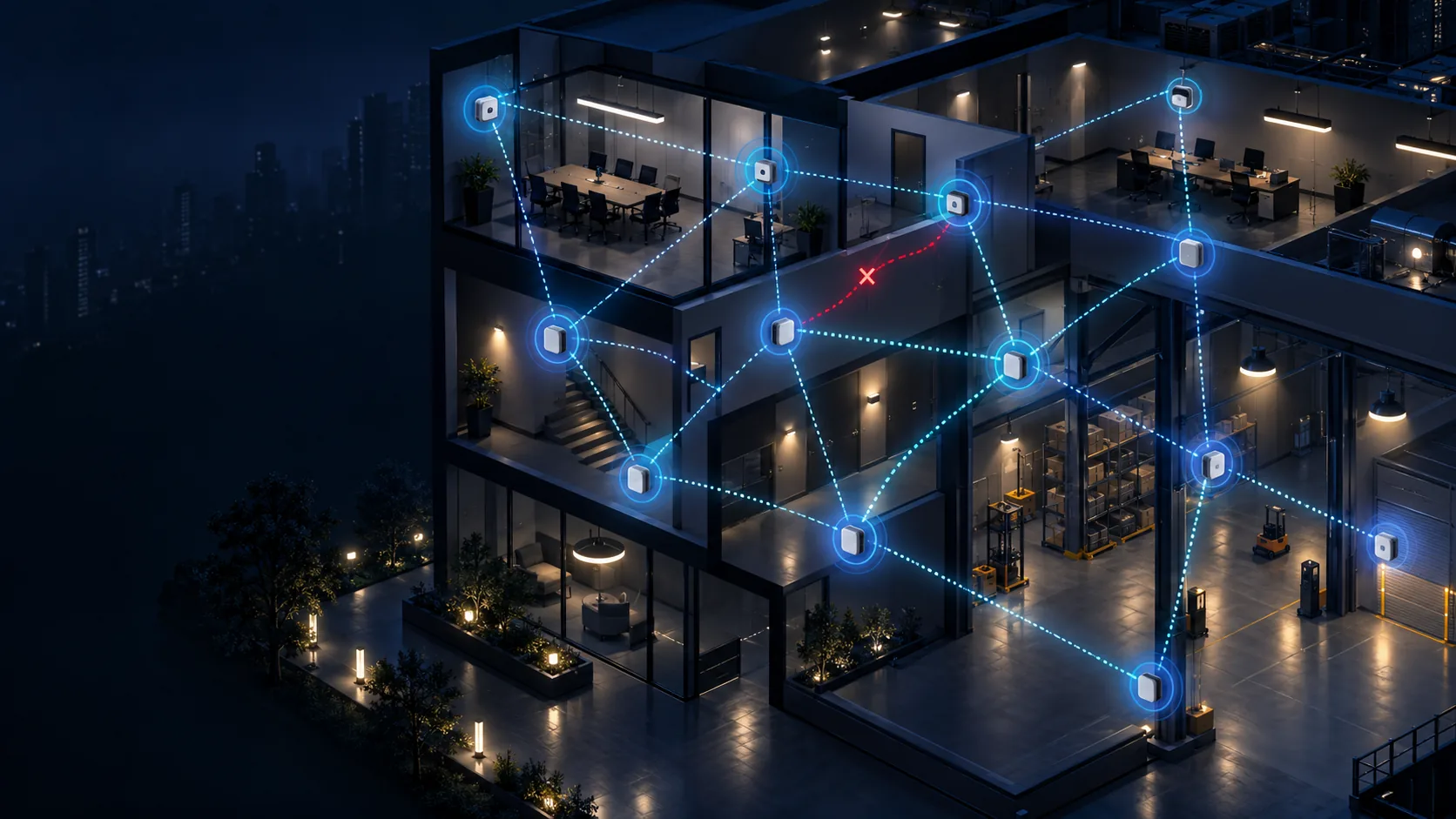
Mesh Topology and Message Flooding
BLE mesh doesn't route messages node-to-node along a calculated path the way a traditional mesh network protocol does — it floods them. A message is broadcast to every node in radio range, each of which relays it onward (subject to a time-to-live counter that prevents infinite propagation), until it reaches every node in the network. This is deliberately simple compared to routed mesh protocols, trading some efficiency for robustness: there's no routing table to maintain or recalculate when a node drops out, since the flood simply finds another path through whichever nodes remain.
Provisioning: Adding a Device to the Mesh
Provisioning is the process of securely adding a new, unprovisioned device to an existing mesh network — establishing shared network and application keys over an encrypted provisioning link before the device can send or receive normal mesh traffic. This step matters more in mesh than in simple point-to-point BLE pairing because a compromised provisioning process could let an unauthorized device join the entire network at once rather than just a single connection, so the provisioning protocol includes authentication steps (a PIN, an out-of-band code, or a public-key exchange) specifically to prevent that.
Node Roles: Relay, Proxy, Friend, and Low Power
Not every node in a BLE mesh behaves identically. Relay nodes forward messages to extend range; proxy nodes bridge the mesh to a standard BLE-connected device like a phone that doesn't implement the full mesh advertising stack; friend nodes cache and forward messages for battery-constrained low-power nodes, which sleep most of the time and can't listen continuously for mesh traffic the way a mains-powered relay node can — the same sleep-and-wake power budgeting covered in our battery-powered IoT power optimization guide applies directly to designing a low-power mesh node. Assigning these roles correctly during network design — putting friend and relay capability on mains-powered nodes and low-power behavior on battery nodes — is what makes a mixed battery and mains-powered mesh work efficiently rather than draining battery nodes trying to relay traffic they were never meant to carry.
Practical Use Cases
Commercial and industrial lighting control is the use case BLE mesh was largely designed around — hundreds of light fixtures in a building, each individually addressable and groupable, without running a separate control wire to every fixture. Sensor networks for building automation (occupancy, temperature, air quality across many rooms) and industrial monitoring where wired sensor runs aren't practical are a similarly strong fit. For simpler products — a single sensor talking to one gateway, or a phone-paired wearable — standard point-to-point BLE remains the simpler and lower-overhead choice; see our ESP32 IoT development guide for when standard BLE or Wi-Fi outperforms the added complexity of a mesh.
When Mesh Isn't the Right Fit
BLE mesh adds real complexity — provisioning infrastructure, key management, and network commissioning tools that a point-to-point product doesn't need — and that overhead only pays off once a deployment reaches enough nodes and enough physical area that a star topology genuinely can't cover it. A handful of sensors in a single room rarely justifies a mesh architecture; the crossover point is usually somewhere in the dozens of nodes or when coverage area exceeds a single radio's practical range, whichever comes first.
Mesh Security: Network and Application Keys
BLE mesh security operates on two separate key layers rather than one: a network key that every device on the mesh shares and uses to authenticate and encrypt messages at the network layer, and application keys that are scoped to specific functions (lighting control versus sensor reporting, for instance) so a device provisioned for one application can't decrypt traffic belonging to another even though it sits on the same physical mesh. This separation lets a mesh network segment functionality without segmenting the radio network itself, and it means a compromised application key doesn't automatically expose every other function running on the same mesh. Key refresh procedures also let an operator rotate the network key across every device if a key is ever suspected to be compromised, without needing to physically re-provision each node from scratch.
How PAK-EL LAB Can Help
PAK-EL LAB designs BLE mesh hardware and firmware for lighting control, sensor networks, and building automation products, including provisioning and commissioning tooling. If you're evaluating whether BLE mesh is the right architecture for your product, our team can help scope it before development starts.
Related services: ESP32 & UWB Development · IoT Product Development