Overview
Most embedded system failures don't show up on the bench. A board that runs flawlessly for a week of testing can lock up in the field three months later, and the failure modes that cause this are a short, well-known list: unhandled lockups, power dips that reset logic mid-operation, memory that quietly degrades over days of uptime, and communication links that drop under exactly the conditions a lab test never reproduces. None of these are exotic — they're the normal cost of shipping a device that has to run unattended, on real power, for a long time. What separates a reliable product from a fragile one is whether the firmware and hardware were designed to expect these failures and recover from them, rather than assume they won't happen.
Watchdog Timers and Lockup Recovery
A watchdog timer is the simplest and most effective defense against a hung main loop: if firmware doesn't "pet" the watchdog within a set interval, the microcontroller resets itself rather than staying frozen indefinitely. The mistake that undermines this protection is petting the watchdog from a low-priority background task instead of from the point in the main loop that actually confirms forward progress — a design that does this can hang the very logic the watchdog is meant to catch while still resetting the timer on schedule. A watchdog is only as good as where it's fed from, and that placement deserves the same scrutiny as any other architectural decision covered in our firmware development best practices guide.
Brownout and Power-Related Resets
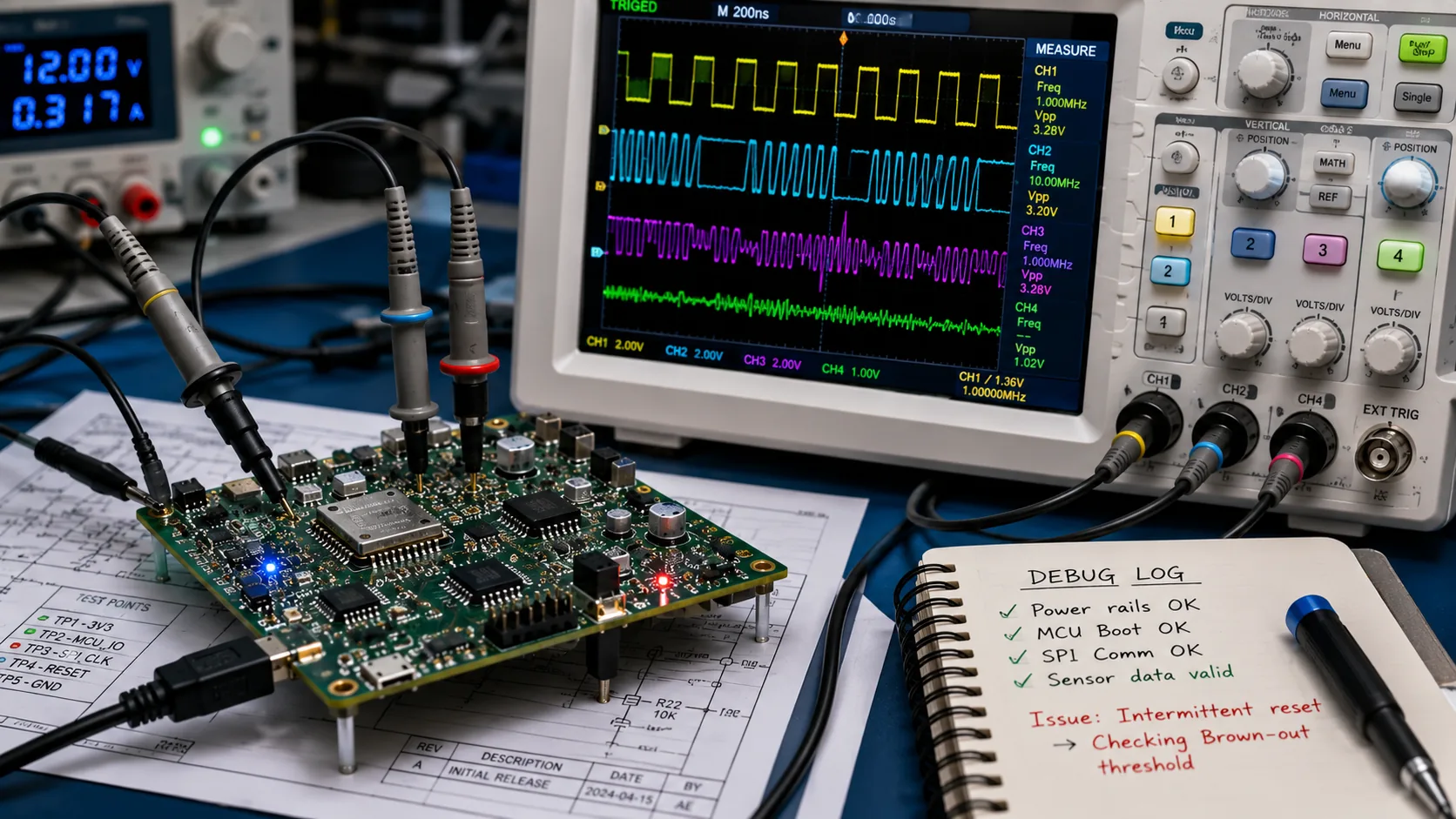
A voltage dip during a Wi-Fi transmission burst, a motor inrush current, or a battery nearing end-of-discharge can drop supply voltage below the level a microcontroller needs to operate reliably — and if that dip isn't caught, the chip can execute garbage instructions before it eventually resets, corrupting flash writes or leaving peripherals in an undefined state. Enabling the microcontroller's built-in brownout detector, sizing bulk and decoupling capacitance for the actual transient current draw (not just steady-state load), and giving the regulator enough headroom above the minimum operating voltage all address this at the hardware level. Products that run on battery need this analysis carried through the whole discharge curve, not just at nominal voltage — a concern we cover in more depth in reducing power consumption in battery-powered IoT devices.
Memory Leaks and Heap Fragmentation
Embedded systems that run for weeks or months are far less forgiving of memory mistakes than a desktop application that gets restarted daily. A slow leak — a buffer allocated on every sensor read and never freed, a string concatenation that grows unbounded — can take days to exhaust available RAM, which makes it invisible in a short bench test and devastating in the field. Heap fragmentation is the quieter version of the same problem: even with enough total free memory, repeated allocation and deallocation of different-sized blocks can leave no single contiguous block large enough for a new allocation, causing a failure that looks random. The most reliable fix is architectural — favor static allocation and fixed-size buffer pools over dynamic `malloc`/`free` in code paths that run continuously, and where dynamic allocation is unavoidable, monitor free heap and fragmentation as part of routine field telemetry rather than only during development.
Communication Failures and Protocol Robustness
Every communication link a device depends on — I2C to a sensor, UART to a companion module, Wi-Fi or LoRa to the outside world — will drop out or return corrupted data at some point, and firmware that assumes otherwise is one noisy environment away from a fault. I2C bus lockups, where a slave device holds the clock or data line low indefinitely, are a classic example that a naive driver never recovers from without a bus reset sequence and a timeout on every transaction. Wireless links need the same discipline: reconnect logic with backoff, message sequence numbers or checksums to detect corruption, and a defined behavior for what the device does with stale data rather than just waiting silently. Choosing a microcontroller with enough peripheral flexibility to implement this kind of defensive I/O — covered in our ESP32 vs STM32 vs RP2040 comparison — matters more once a product has to survive real-world RF and electrical noise.
Fault Logging and Field Diagnostics
A device that fails in the field and gives no indication of why turns every warranty return into a guessing game. Persistent crash logging — recording the fault type, program counter, and a stack snapshot to flash before or during a reset — turns "it just stopped working" into an actual root cause the next time the device is connected for service or OTA update. Recording reset reason (watchdog, brownout, external, power-on) on every boot and reporting it back to the cloud alongside normal telemetry costs very little to implement and is often the single most useful piece of data for triaging a fleet-wide reliability issue before it becomes a large-scale warranty problem.
How PAK-EL LAB Can Help
PAK-EL LAB designs embedded hardware and firmware with these failure modes accounted for from the first architecture decision — watchdog placement, brownout protection, memory-safe patterns, and fault logging that makes field issues diagnosable instead of mysterious. If a product is coming back with intermittent faults you can't reproduce on the bench, our team can help track down the root cause.
Related service: Embedded Firmware Development