Overview
Safety systems on a vessel carry a stricter requirement than general marine monitoring: they need to keep working reliably in the same salt-laden, vibration-heavy environment covered in our marine monitoring electronics guide, but with far less tolerance for a missed alert or a false negative. A bilge water sensor, a fire or gas detection system, or a man-overboard alarm has to fail safe, not just fail gracefully, because the cost of a missed event on the water is measured very differently than a missed reading on a monitoring dashboard.
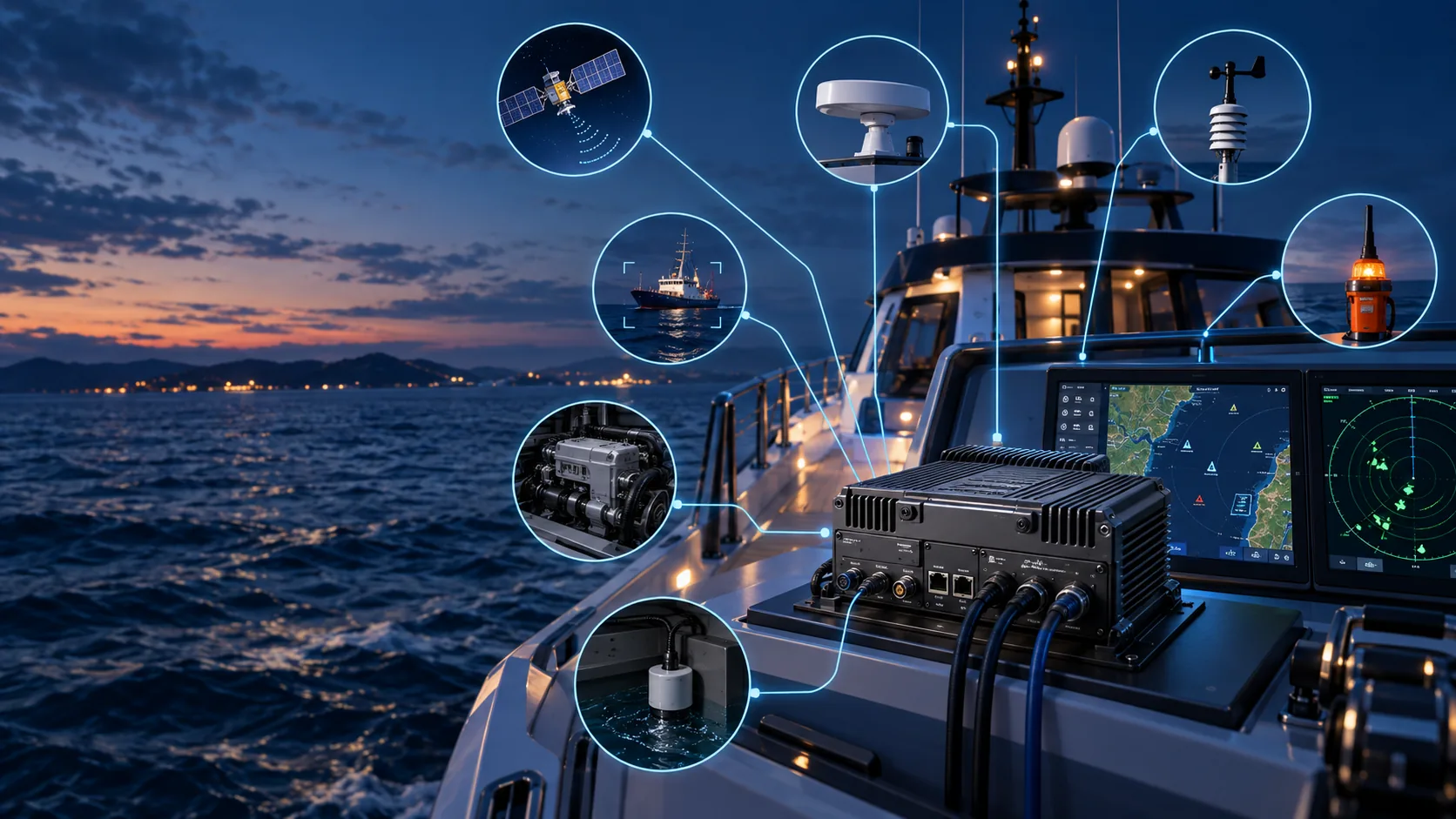
Smart Safety System Categories
Marine smart safety systems typically cover a handful of recurring functions: bilge water level and pump monitoring to catch a flooding condition early, gas and fire detection in engine rooms and enclosed spaces, man-overboard alerting tied to wearable or fixed sensors, and automated shutdown logic that reacts to a detected fault without waiting for a human operator to notice it. Each of these functions benefits from local decision-making at the sensor or a nearby controller rather than depending entirely on a central system that could itself be the point of failure.
Corrosion-Resistant Design Fundamentals
Every material choice on a marine safety system has to assume constant exposure to salt air and, for some installations, direct water contact. Conformal coating on PCBs, marine-grade connectors with sealed contacts, and enclosures rated to the correct IP class for their mounting location are the baseline, not an upgrade option. Galvanic corrosion between dissimilar metals is a specific risk on a vessel that a land-based design rarely has to consider — fasteners, connector shells, and mounting hardware need to be chosen as a compatible set, not picked individually for cost, or a mismatch will corrode preferentially at the joint faster than either metal would on its own.
Sensor Redundancy for Safety-Critical Functions
A single point of sensing failure is an acceptable risk for a monitoring dashboard and an unacceptable one for a safety system. Redundant sensors — two independent bilge water sensors rather than one, for instance — combined with a voting or cross-check logic that flags a disagreement between them rather than silently trusting whichever one happens to still be working, catches the specific failure mode where a corroded or fouled sensor reports a false "all clear" instead of the fault it should be detecting. The added hardware cost of a second sensor is small relative to the cost of a missed flooding or gas event, which is exactly the trade-off that justifies redundancy on a safety function even when the same duplication would be hard to justify on a routine monitoring channel.
Power Resilience and Failover
Marine electrical systems are prone to noise and transients from engine starting and generator switching, and a safety system in particular cannot be allowed to reset or lose state during a normal electrical event on the vessel's DC bus. Battery backup sized for the system's expected runtime during a main power loss, combined with brownout-tolerant firmware that preserves alarm state across a power dip rather than requiring a clean boot to resume monitoring, is standard practice for anything classified as a safety function rather than general telemetry — the same brownout and reset-resilience discipline covered in our common embedded system failures guide applies with less tolerance for error on a safety-rated function.
Alerting and Communication
A safety alert has to reach the people who need to act on it through more than one path where possible: a local audible and visual alarm on the vessel itself as the primary notification, backed by remote alerting over whatever connectivity the vessel has available — cellular near shore, satellite offshore — so a shore-based operator or fleet manager is notified even if no one is near the local alarm when it triggers. Designing the alert path to degrade gracefully, rather than depending entirely on one connectivity option, matters more for a safety system than it does for routine monitoring data.
Testing and Commissioning Before Sea Trials
A safety system that hasn't been tested against realistic fault conditions before a vessel leaves port hasn't really been validated, whatever its bench performance looked like. Commissioning should include deliberately triggering each sensor's fault condition — flooding a bilge sensor's test input, simulating a gas concentration reading, disconnecting a redundant sensor pair — to confirm the alarm actually fires and reaches every intended notification path, not just that the sensor reports a plausible value under normal conditions. Periodic re-testing on a schedule matched to the corrosion and fouling risk of the specific environment catches sensor degradation before it becomes a live failure, since a corroding connector or a fouled sensor face tends to fail gradually rather than all at once, and gradual degradation is exactly the failure mode a one-time commissioning test won't catch on its own.
How PAK-EL LAB Can Help
PAK-EL LAB designs marine safety electronics built for the corrosion, vibration, and power conditions a vessel produces — from sensor selection and redundancy architecture to alerting and connectivity. If you're developing a marine safety system, our team can help design it to fail safe in the environment it will actually operate in.
Related service: Marine Electronics