Overview
The cost of fixing a design flaw multiplies at every stage it survives. A wiring or firmware bug caught on a prototype costs an engineer a few hours. The same flaw discovered after tooling is committed means reworked molds or a redesigned board spin. Discovered after mass production, it means a recall, a warranty bill, and a damaged reputation with whoever bought the product. Prototype testing exists specifically to catch problems at the cheapest possible point, and skipping it — or rushing it to hit a launch date — is one of the most expensive shortcuts a hardware team can take.
Functional Testing Before Tooling
Functional testing verifies that a prototype does what it's supposed to do under normal operating conditions: sensors read correctly, communication links connect and hold, the user interface responds as designed, power draw matches the budget. This sounds basic, but it's where the majority of real design flaws surface — a sensor that needs recalibration, a communication protocol that doesn't handle a specific edge case, a firmware state machine that locks up under a sequence of inputs nobody thought to test manually. Running this pass thoroughly before committing to tooling or a PCB production run means these fixes are a firmware update or a schematic change, not a hardware respin. Choosing between a custom board and off-the-shelf development boards for this stage has its own cost tradeoffs, covered in our custom PCB vs development boards comparison.
Environmental and Stress Testing
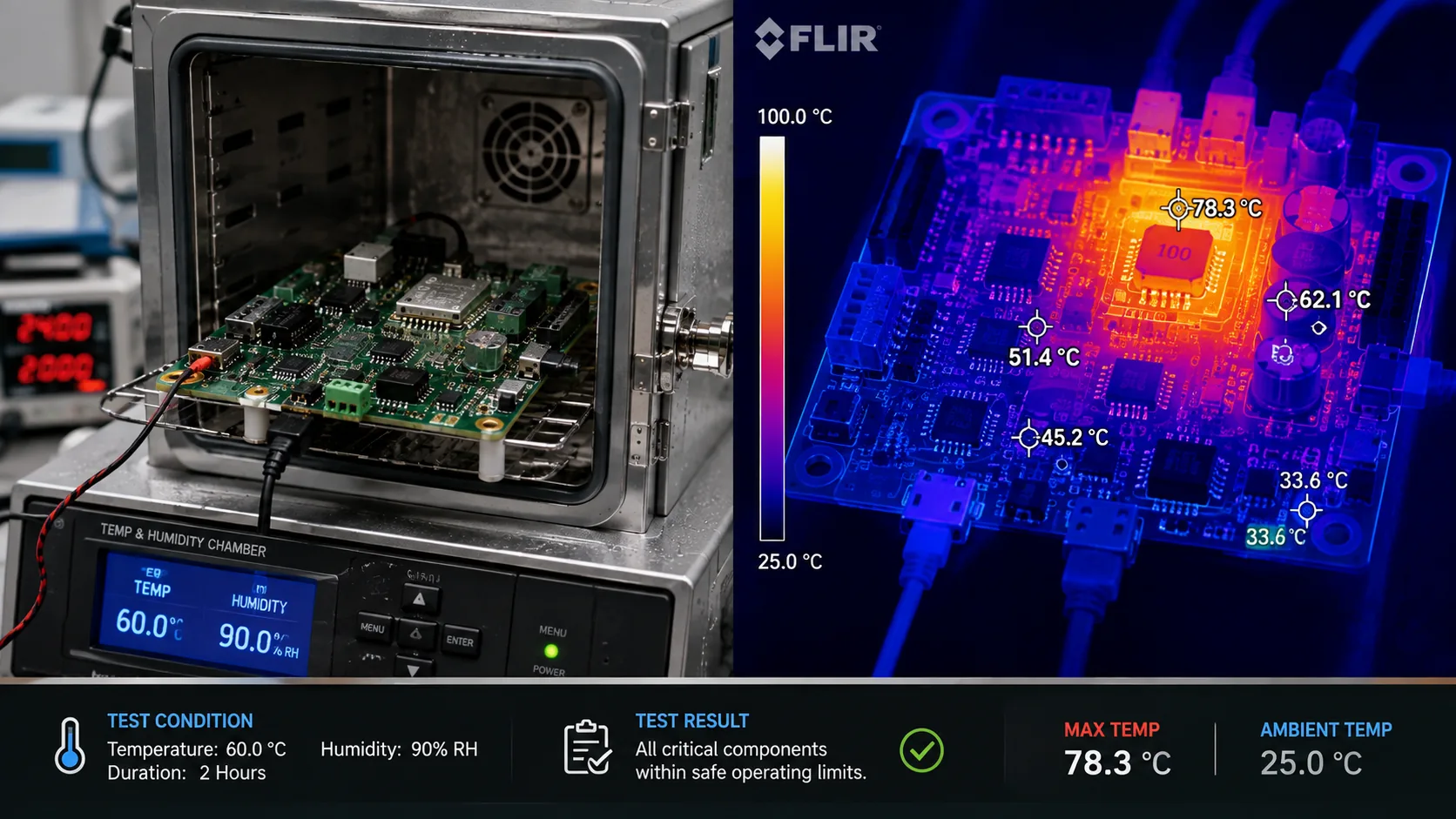
A prototype that works perfectly on a lab bench at room temperature tells you almost nothing about how it will behave in the environment it's actually shipping into. Environmental testing exposes the prototype to the temperature range, humidity, vibration, and ingress conditions the finished product will face — a marine enclosure needs salt-fog and water-ingress testing, an automotive module needs thermal cycling and vibration testing, an outdoor industrial sensor needs both temperature extremes and condensation resistance. Stress testing pushes further: running the device at the edges of its rated conditions, or beyond them, to find the actual failure margin rather than assuming the datasheet numbers hold in a real enclosure with real thermal coupling between components. Products destined for demanding environments — our work on marine monitoring systems is a good example — depend on this stage to catch corrosion and sealing issues before a single unit reaches the field.
Design Validation and Iteration Cost
Design validation is the discipline of confirming the prototype actually meets the original requirements, not just that it powers on and does something plausible. This is where a second or third prototype iteration earns its cost: each round narrows the gap between what was specified and what was built, and catches the interactions between subsystems that only show up once the whole device is assembled — a firmware timing assumption that doesn't hold once real sensor noise is present, or an enclosure that traps heat in a way the thermal simulation didn't predict. The math strongly favors doing this before manufacturing: an extra prototype run typically costs a fraction of what a single field recall or a redesigned injection mold costs later, and it's far easier to negotiate a spec change on a hand-built unit than on a production line already committed to a BOM.
Common Failures Prototype Testing Catches Early
The failures that prototype testing is specifically good at surfacing are the ones that don't show up in a quick bring-up: intermittent connector faults that only appear under vibration, EMC issues that pass a casual bench test but fail formal compliance testing, battery life that looks fine over an hour but falls short over a full duty cycle, and firmware edge cases that only trigger after days of continuous operation. Our guide to common embedded system failures covers many of these same failure modes from the firmware side — watchdog placement, brownout handling, and memory issues that a short bench test simply won't expose, but that days of prototype soak testing reliably will.
Building a Testing Plan Into Your Timeline
The teams that get the most value from prototype testing treat it as a scheduled phase with a defined pass/fail criteria, not an open-ended "see if it works" step squeezed in before launch. That means deciding upfront which tests are mandatory (functional verification, EMC pre-scan, basic environmental exposure) versus which are situational (extended vibration testing for a vehicle-mounted product, salt-fog testing for marine equipment), and budgeting real calendar time for at least one design iteration based on what the first round of testing finds. A testing plan written into the project timeline from day one is far cheaper than testing added as a reaction to a problem discovered after tooling is already paid for.
How PAK-EL LAB Can Help
PAK-EL LAB builds prototype testing into every product development engagement — functional verification, environmental and stress testing matched to the deployment conditions, and design validation before a client commits to tooling or a production run. If you're planning a launch and want the prototype stage done properly, our team can help scope a testing plan that fits your timeline and budget.
Related service: IoT Product Development