Overview
Wireless connectivity gets most of the attention in embedded product design, but wired Ethernet remains the backbone of industrial and reliability-critical systems for reasons that have not gone away: it is far less susceptible to RF interference from nearby motors and switching equipment, it can carry both power and data over a single cable, and it does not depend on spectrum availability or an access point staying up. Any embedded system destined for a factory floor, a vessel's engine room, or a building's control room eventually needs an Ethernet interface designed with the same care as its wireless counterpart.
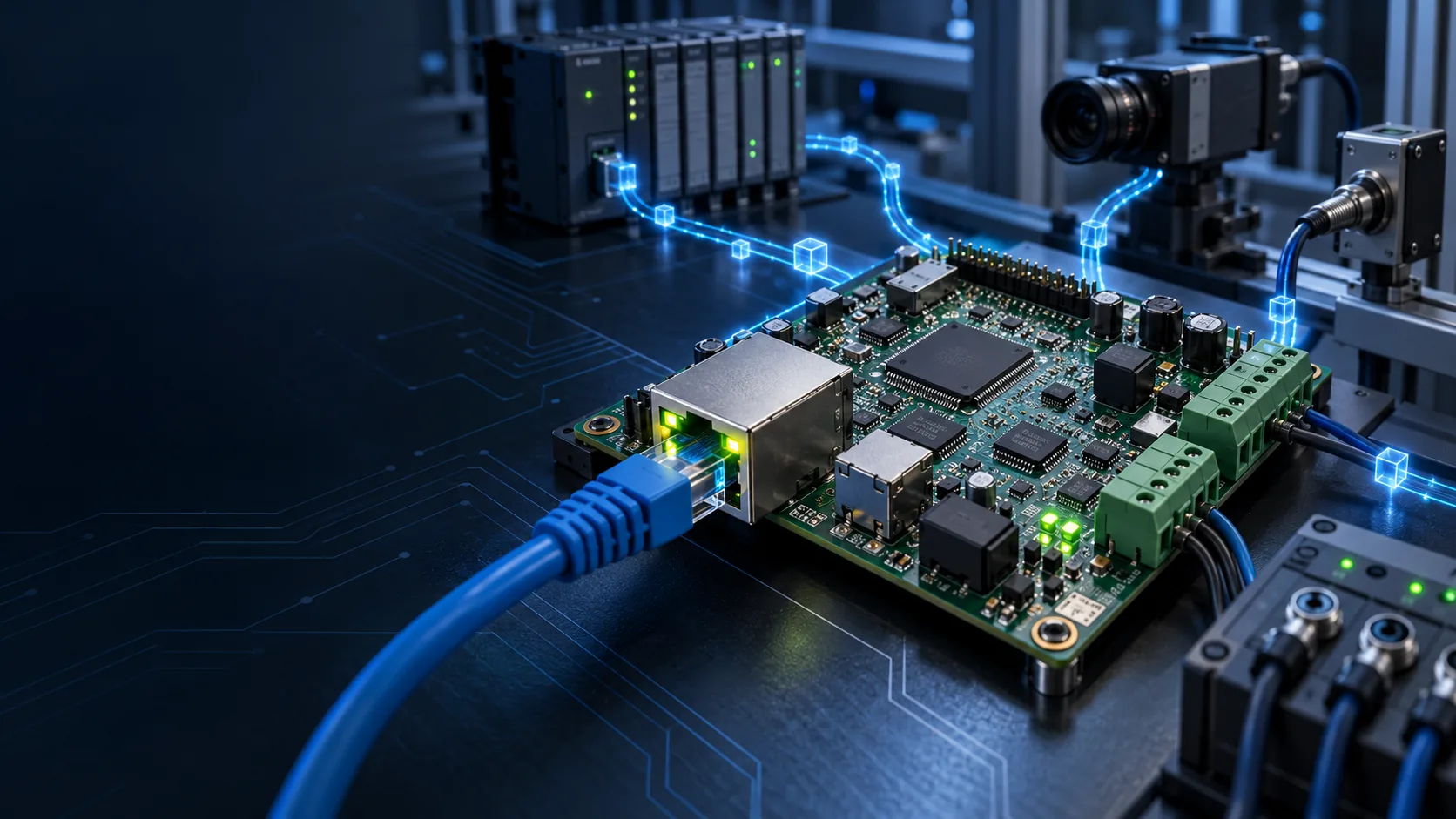
Why Choose Wired Ethernet Over Wireless
Wireless links share spectrum with every other radio in range, and an industrial environment full of motors, VFDs, and switching power supplies is a genuinely hostile RF environment — dropped packets and retries are the norm, not the exception, in the electrically noisy areas where reliability matters most. A wired Ethernet link, by contrast, degrades predictably: a cable fault shows up as a clear link-down event rather than an intermittent, hard-to-diagnose packet loss pattern. Ethernet also supports deterministic, low-jitter communication when the application calls for it — something consumer Wi-Fi was never designed to guarantee — which is why safety-related and closed-loop control systems still default to a wired connection even in facilities that use wireless everywhere else, including the Wi-Fi, LoRa, and cellular links covered elsewhere on this blog.
PHY, MAC, and Common Embedded Interfaces
Adding Ethernet to an embedded design means choosing between using a microcontroller's built-in MAC over RMII or MII to an external PHY chip, or offloading the entire TCP/IP stack to a SPI-connected Ethernet controller such as the WIZnet W5500 or W5100S. The SPI-controller route is the simpler path for a microcontroller with no built-in Ethernet MAC — it hands the whole stack to the companion chip and talks to it like any other SPI peripheral, at some cost in throughput compared to a native MAC/PHY pair. STM32 parts with an integrated Ethernet MAC, paired with an external PHY over RMII, are the more common choice when a design needs higher throughput or is already committed to an STM32-based architecture — see our microcontroller comparison for how that decision plays into overall platform choice, and our high-speed PCB design guide for the layout side of routing RMII and magnetics correctly.
Power over Ethernet for Remote Devices
Power over Ethernet lets a single cable run carry both data and power to a remote device, which is valuable for sensors and controllers in locations without convenient AC wiring — a common requirement in marine monitoring systems and building automation alike. Designing a PoE input means adding an isolated DC-DC stage rated for the PoE class the device needs (IEEE 802.3af/at/bt define increasing power budgets) and giving that isolation barrier proper creepage and clearance on the PCB — a detail that is easy to underestimate until a design fails safety certification over spacing that looked fine on screen but not on the actual board.
Industrial Protocols over Ethernet
Ethernet is also the physical layer under most modern industrial fieldbus protocols. Modbus TCP wraps the familiar Modbus register model in a standard TCP/IP packet, making it the easiest migration path for systems already using serial Modbus RTU alongside 4-20mA signal loops. EtherCAT and PROFINET go further, using real-time extensions on top of standard Ethernet hardware to hit the deterministic, sub-millisecond cycle times that motion control and closed-loop automation need — timing performance a general-purpose TCP/IP stack cannot guarantee on its own. Choosing between them comes down to what the rest of the plant already runs and how tight the control loop's timing budget actually is; retrofitting real-time Ethernet onto a system designed around plain Modbus TCP is a much bigger change than picking correctly at the start.
Reliability, EMC, and Cabling Considerations
Industrial Ethernet ports need isolation transformers — usually built into the RJ45 magjack — between the PHY and the cable to block ground loop currents and surge energy from reaching sensitive digital circuitry, along with TVS protection on the line side for equipment exposed to lightning-induced surges or motor switching transients. Shielded cable and connectors matter more in an industrial cabinet full of VFDs and contactors than they would in an office, and grounding the shield at one end only (or per the specific noise environment) avoids introducing the same ground loop the isolation transformer was meant to prevent. These are the same categories of failure covered in our guide to common embedded system failures — most Ethernet reliability problems trace back to skipped isolation or grounding shortcuts taken to save board space.
When to Combine Ethernet with Wireless
None of this rules out wireless — many products use wired Ethernet for the primary control and safety path while adding Wi-Fi or cellular for dashboards, remote monitoring, or firmware updates that do not need the same guaranteed uptime. The design principle that holds regardless of the mix: anything safety-related or time-critical goes over the wired link, and anything that can tolerate the occasional retry or outage — supervisory telemetry, an app connection, an OTA update — can reasonably use wireless instead.
How PAK-EL LAB Can Help
PAK-EL LAB designs Ethernet-connected embedded hardware for industrial and reliability-critical products — PHY and magnetics layout, PoE power stages, and protocol integration for Modbus TCP and other industrial Ethernet standards. If your product needs a wired connectivity design that holds up in a demanding environment, our team can help.
Related services: Automation Systems · 4-20mA Signal Systems